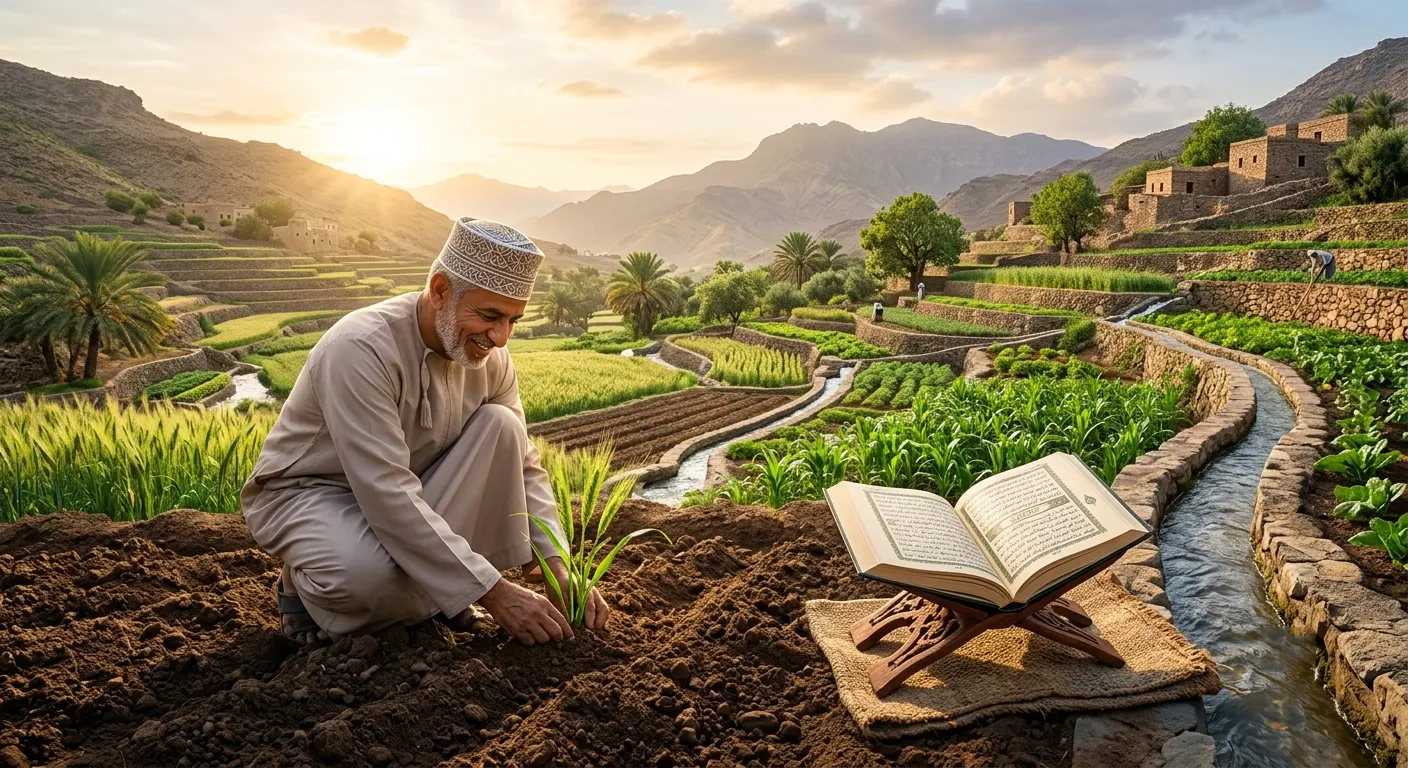
1. Soil: A Living and Miraculous ‘Industry’
The Holy Quran presents soil not merely as inanimate matter, but as a disciplined production center.
“And Allah has caused you to grow from the earth.” (Surah Nuh 71:17)
● Significance: Allah has embedded a “mechanism” within the soil that takes dead elements and transforms them into living cells. This proves that agriculture is not just human labor, but a processed harvest from a natural factory established by Allah.
2. Interaction of Rainwater and Soil: Input and Processing The Quran repeatedly mentions the descent of water from the sky and the revival of the earth as a process under direct Divine control.
“Then We cracked the earth open [with sprouts] and caused to grow within it grain…” (Surah Abasa 80:26-27)
● Productivity Philosophy: Modern science calls this the “hydrological cycle,” but the Quran views it as Allah’s “Provision Management.” Rainwater is the celestial “input” that awakens the latent potential within the soil. The permeability of the soil is a specific feat of Divine engineering.
3. Diverse Production and Soil Characteristics (Surah Ar-Ra’d 13:4)
The production of crops with different tastes and qualities from the same water and soil is cited as one of Allah’s greatest signs.
“And on the earth are neighboring tracts and gardens of grapevines and crops and palm trees… watered with one water; but We make some of them exceed others in quality of fruit.”
● Significance: This points to the Creator’s unrivaled influence over genetic engineering and the diversity of soil productivity. It provides food for thought for agricultural scientists: why are results different despite identical basic elements?
4. Three Pillars of Agricultural Philosophy
Surah Al-Waqi’ah (56:63-64) shatters human arrogance with a fundamental question:
“Have you seen that which you sow? Is it you who makes it grow, or are We the grower?” Based on this, three core lessons emerge for research:
1. Humans as Agents (Wasilah): The farmer only sows the seed (labor), but the infusion of life and growth is the work of Allah (the designated system).
2. Trusteeship of Resources: Since production is in Allah’s hands, arrogance regarding land ownership or harvests is misplaced. This acts as a moral barrier against hoarding and artificial crises.
3. Gratitude and Distribution: Paying gratitude to Allah and providing the portion for humanity (Zakat/Ushr) during harvest is a spiritual and economic obligation.
5. Soil Fertility and Resurrection
The Quran often uses the revival of dead land as evidence for the Resurrection.
● The Connection: Just as plants find life from dead soil, it is easy for Allah to recreate humans from remains. This philosophy instills the awareness that one must eventually account for their actions on this earth.


 English
 Bengali
2 thoughts on “Soil and Agriculture: The Quranic Philosophy of Productivity and Miraculous Mechanisms.”
Very informative
I found better something here and learned a lot.